
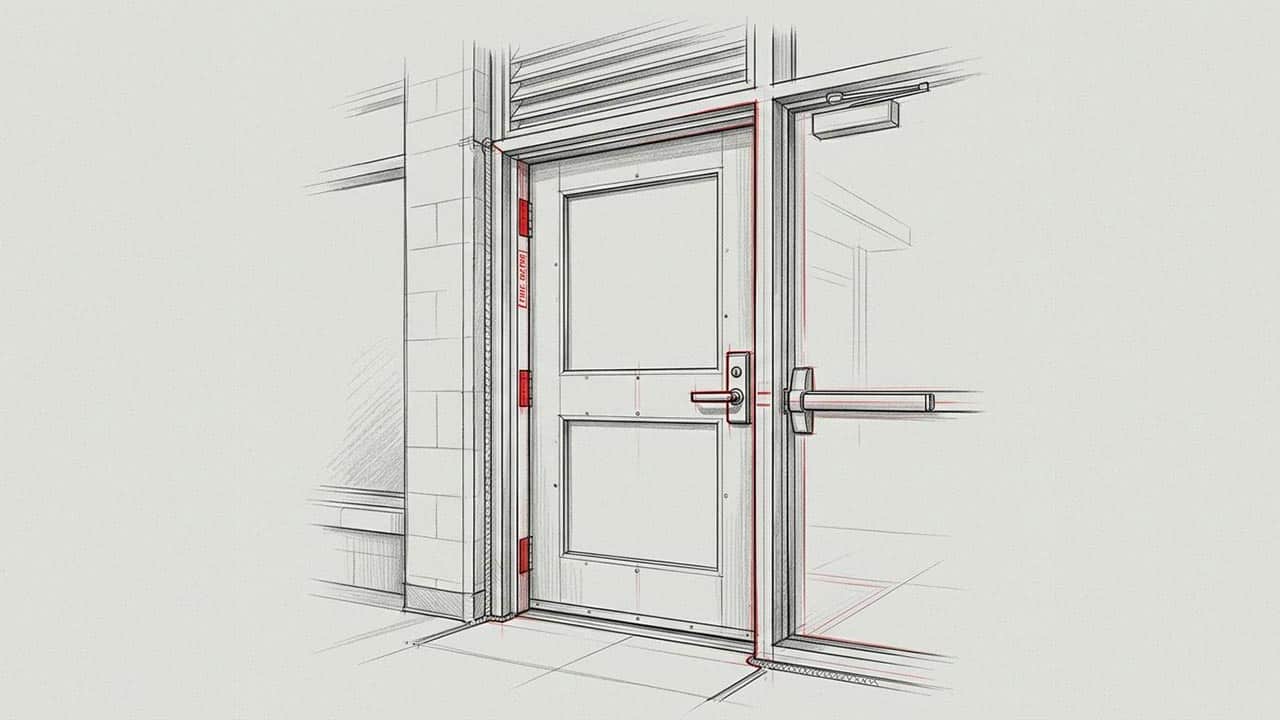
Investing in professional replacement of your commercial door is the most effective way to address issues that create more than just an eyesore. Gaps around the perimeter, weak latching, worn door hardware, and worn frames can expose a building to unauthorized entry, air loss, safety risks, and recurring repair costs.
A well-planned upgrade does more than just replace the door itself. It can strengthen security solutions, support safe egress, reduce maintenance calls, and incorporate energy efficient designs that restore the performance required for fire-rated or high-traffic openings.
Facility teams, contractors, and building owners should treat each replacement as a complete opening project, not a simple panel swap.
Key Takeaways
- View openings as complete systems: A successful replacement involves coordinating the door, frame, and hardware as one integrated assembly rather than swapping individual components.
- Identify end-of-life indicators: Frequent maintenance, visible rust, warped frames, and operational issues like dragging or failing to latch signal that a full replacement is more cost-effective than piecemeal repairs.
- Prioritize code compliance: All components in fire-rated and high-traffic openings must be compatible and properly labeled to ensure life safety, security, and successful facility inspections.
- Ensure accurate pre-installation planning: Precise field measurements, detailed site photos, and thorough verification of existing conditions prevent costly change orders and delays during the installation process.
- Invest in professional installation and maintenance: Proper installation of frames and hardware is vital for performance, while regular inspections extend the lifespan of the opening and maintain building security.
Signs It's Time for to Replace your Commercial Door
Commercial doors absorb daily abuse from carts, equipment, weather, heavy traffic, and attempted forced entry. While some minor issues can be addressed with standard commercial door repair or occasional emergency repair services, repeated service calls usually indicate that the opening has reached the end of its useful life. In many cases, replacing the door, frame, and hardware as a complete unit is more cost-effective and less time consuming than piecemeal repairs that fail to restore proper alignment or security.
Damage, Poor Fit, and Repeated Repairs
In high traffic environments, doors face significant wear that eventually compromises their structural integrity. You should consider a full replacement if you notice the following signs:
- Visible rust at the bottom of steel doors or frames.
- Dents, warping, or cracked faces that impede smooth operation.
- Loose hinges or noticeable shifting in the frame.
- A door that binds, drags, rattles, or requires excessive force to latch.
- Large gaps at the head, jambs, or meeting edges that allow air, moisture, smoke, or noise to pass through.
Security, Fire, and Energy Performance Gaps
Outdated locks, loose strike plates, failing closers and weak frames create obvious security vulnerabilities. Beyond security, weatherstripping, thresholds, door bottoms, and perimeter seals are critical for controlling operating costs and maintaining fire-ratings along with occupant comfort.
Fire-rated openings require strict attention to detail. Every component, including the door, frame, hinges, latch, closer, and glazing, must be compatible with the labeled assembly. Replacing a labeled door with an unlisted panel, drilling unapproved holes, or installing the wrong vision lite can compromise the opening and lead to failed inspections.
For exterior and conditioned-space openings, carefully select the door core and perimeter sealing package. Insulated steel doors with polyurethane or polystyrene cores limit heat transfer more effectively than standard hollow metal constructions. Ultimately, the performance of the entire operable assembly matters, which is why utilizing professional door installation services is the best way to ensure your new commercial doors provide long-term security and energy efficiency.
Choose the Right Replacement Door for the Building
The right replacement depends on traffic, location, wall construction, code requirements, security exposure, and maintenance expectations. A receiving door in an industrial facility needs different features than a patient-room door, a school corridor opening, or an exterior electrical-room entrance.
Specify the door, frame, hardware, glazing, and accessories as one coordinated system. A strong door cannot compensate for a loose frame or an undersized lock.
Hollow Metal and Steel Doors for Strength and Security
Hollow metal doors and frames are common in schools, offices, healthcare facilities, warehouses, industrial plants, and multifamily buildings. They handle frequent use, resist impact, and provide a dependable foundation for commercial-grade hardware.
Steel also offers a strong price-to-performance balance for maintenance and security. Properly finished hollow metal doors resist routine abuse and with proper installation and care, steel door assemblies can remain in service for decades.
Where security requirements increase, steel openings can support reinforced frames, continuous hinges, heavy-duty locks, and panic hardware. They are also available for tested fire rated, acoustic, tornado-resistant, forced-entry-resistant, and blast-resistant applications.
A standard door should never be assumed to meet those specialty requirements. Each complete opening needs the applicable test listing, construction details, and approved hardware.
Fire-Rated, Acoustic, Stainless Steel, and Specialty Options
Fire rated door assemblies protect openings in rated walls, stair enclosures, corridors, shafts, and other Division 8 code-required locations. Steel doors can be listed for ratings up to three hours, depending on the assembly. The label, rating, frame, glazing, and hardware must match the project requirements.
Acoustic doors are often used in conference rooms, schools, healthcare spaces, recording areas, and mechanical-room separations. Sound-rated steel assemblies commonly offer Sound Transmission Class (STC) ratings that standard doors cannot provide. Door pairs, perimeter seals, automatic bottoms, and vision lites all affect acoustic performance.
For specialized environments stainless steel doors are essential, in food-service, healthcare, laboratory, and chemical-exposure areas. In environments where salt or aggressive chemicals create a corrosion concern, fiberglass doors are also an excellent alternative due to their durability.
Custom doors may be required for oversized openings, uncommon frame depths, unusual hardware, ballistic protection, or controlled-access locations. Confirm every detail before production, including hardware preparation, louvers, vision lites, edge construction, and finish.
Hardware and Access Control That Improve Efficiency
High-quality door hardware determines how a commercial opening feels and performs every day. Hinges carry the weight of the door, door closers control swing speed, locks secure the opening, and panic hardware provides code-required egress.
For busy entries, automatic entry systems and low-energy power operators can improve accessibility and traffic flow. When these systems are ADA compliant, they ensure that every user can navigate the space safely and independently. Card readers, keypads, electrified strikes, and magnetic locks can support access control when they are properly designed for safe egress.
Weatherstripping, sweeps, thresholds, silencers, and gasketing protect comfort and reduce wear. Vision panels in doors, transoms and sidelites in frames both improve sightlines in hospitals, schools, and service corridors, while louvers support airflow where mechanical systems require it.
Hardware should match the opening's use, rating, door weight, traffic level, and security requirements. Mixing incompatible parts often causes premature failure.
How to Plan a Commercial Door Replacement Project
Ordering errors often begin with incomplete field information. A door may look like a standard size, yet the frame depth, hinge locations, wall construction, floor condition, or fire label can make it a custom opening.
Review the existing condition before approving a commercial door replacement. Accurate information protects the project schedule and reduces costly change orders.
Measure the Opening and Confirm Existing Conditions
Field measurements should capture more than door width and height. Verify the rough opening, frame opening, wall thickness, jamb depth, door handing, swing direction, hinge locations, lock preparation, threshold condition, and available clearances.
Also inspect the frame for rust, damage, movement, and out-of-square conditions. A replacement slab may not solve the problem if the existing frame is twisted, loose, or damaged at the anchor points.
Photographs of the opening, labels, hinges, strikes, closers, and surrounding wall are useful during quoting. Construction plans and door schedules add another layer of confirmation, especially on projects with multiple door types or rated openings.
Evaluate Project Costs and Timelines
The purchase price is only one part of the budget. When planning your commercial door replacement, account for the door, frame, hardware, freight, removal, installation labor, field finishing, access-control work, and future maintenance. Keep in mind that the cost of your project will fluctuate based on material choices and specific site conditions.
Differentiate between product lead times and the physical duration of installation. Complex custom orders may require longer lead times, while the labor required for a door frame installation varies based on wall material and site accessibility. To help manage your budget and schedule, we recommend requesting a free estimate.
Request a GET A COMMERCIAL DOOR QUOTE with field measurements, photos, plans, and door schedule details. Clear project information helps produce a more accurate package and avoids delays after the order is released.
Install and Maintain Replacement Doors for Long-Term Results
The quality of the installation process determines whether a replacement opening operates as specified. Even a properly selected door can fail early if professional installers set the frame out of plumb, use incorrect anchors, or skip critical hardware adjustments.
Follow the manufacturer instructions, approved shop drawings, and applicable local code requirements for every opening.
Avoid Common Installation Problems
Frames must be plumb, level, square, and properly anchored before the door and hardware are installed. Incorrect rough opening sizes, over-tightened anchors, missing shims, and poor frame alignment can lead to binding or uneven gaps.
Professional installers should protect factory finishes during handling and construction. Touch-up work may correct minor scratches, but deep damage can expose steel to corrosion.
After installation, adjust hinges, closers, latches, seals, and thresholds. The door should swing freely, close at a controlled speed, latch without force, and provide the required clearances.
Use a Simple Inspection and Maintenance Plan
A regular inspection program catches small defects before they become security or safety failures. Check hinges, fasteners, closers, locks, exit devices, weather seals, thresholds, glazing, and finishes.
Tighten loose hardware, replace worn seals, clear debris from thresholds, and repair corrosion before it spreads. A closer that slams or fails to latch can damage hardware and leave an exterior opening unsecured.
Fire-rated doors need additional attention. Do not wedge them open, remove labels, alter the door without approval, or replace hardware with unlisted components. Routine checks help preserve the assembly intended performance.
Frequently Asked Questions
When is it better to replace a commercial door instead of repairing it?
Replacement is usually the most cost-effective option when you face recurring service calls, structural damage like severe rusting or warping, or when the door can no longer maintain proper fire ratings or security. If the frame is distorted or the existing hardware consistently fails to function, a complete unit replacement provides better long-term reliability than continuous repairs.
Can I replace just the door slab and keep my existing frame?
While it is sometimes possible, it is often not recommended if the existing frame is loose, rusted, or out-of-square. A new door requires a perfectly plumb and level frame to function correctly; if the frame is compromised, the new slab will likely suffer from premature wear, binding, or security gaps.
Why are field measurements so critical for commercial door projects?
Commercial openings often have unique frame depths, custom hardware preps, or specific fire-rating requirements that need to be identified. Precise field measurements and documentation ensure the new assembly fits the specific site conditions, preventing costly delays and ensuring the door operates safely and complies with building codes.
What should I consider when selecting a door for a fire-rated opening?
Every component—including the frame, hinges, closer, latching hardware, glazing, and seals—must be compatible and listed for the specific fire-rating requirement weather your project calls for steel or wood doors. You must never drill unapproved holes or install hardware that is not rated for the assembly, as doing so can compromise the opening and result in failed safety inspections.
A Better Door Opening Starts With the Full Assembly
Commercial door and frame replacement significantly impacts building security, safe egress, energy efficiency, code compliance, and long-term maintenance costs. The most effective results come from selecting a complete, compatible opening system rather than simply replacing the visible door slab. Achieving high performance requires accurate field verification, perfectly coordinated hardware, qualified installation, and a commitment to routine maintenance. By investing in a comprehensive approach to your commercial door replacement, you ensure that your facility remains secure and functional long after the installation team completes the project. A well-specified commercial door unit replacement provides the reliability and durability necessary to protect your building and its occupants for years to come.
